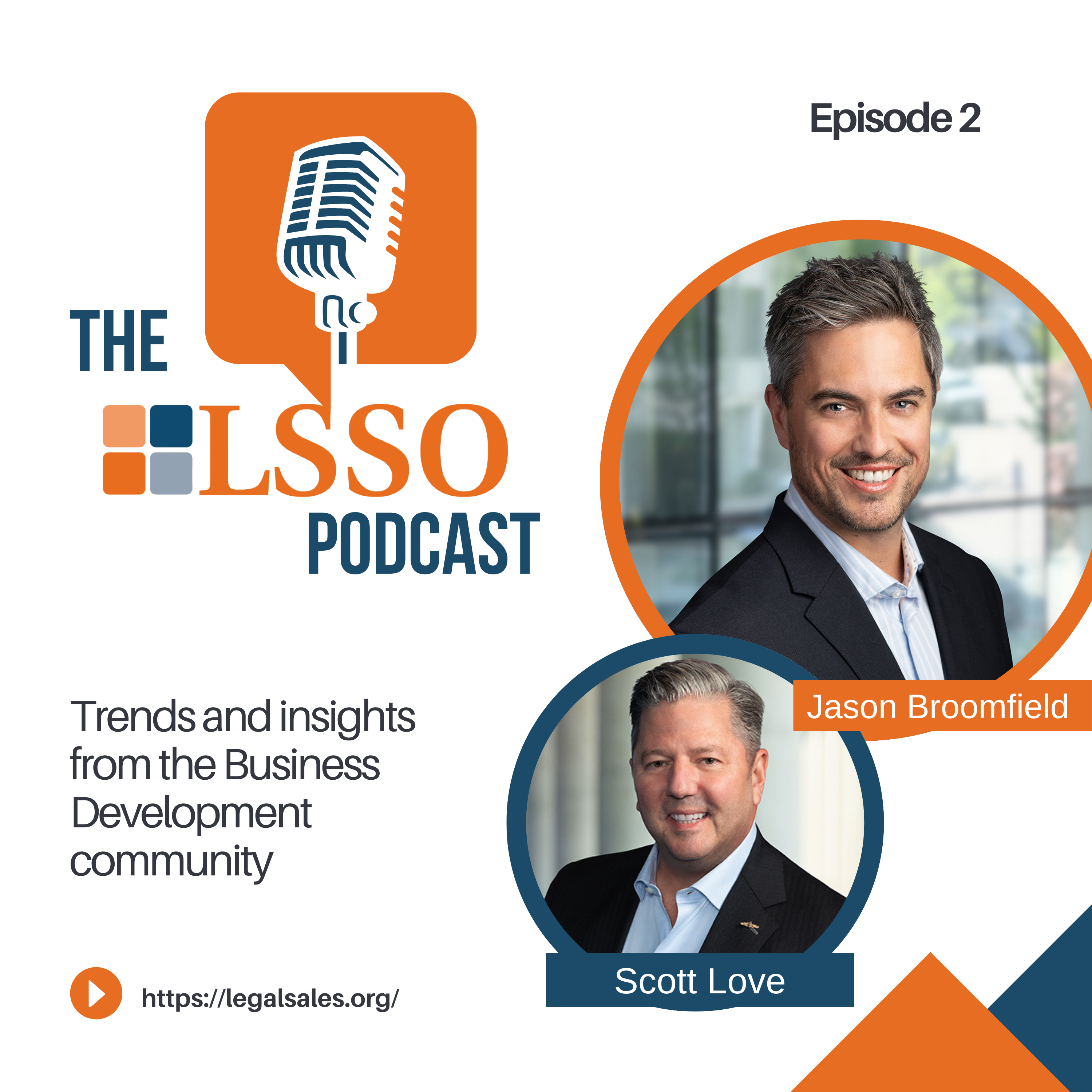
Scott: Hey, this is Scott Love. This is our second episode of the LSSO podcast and our special guest today is Jason Broomfield, Director of Business Development with Nexl. And we're talking about trends and insights from the business development community. Jason, thank you so much for joining me on the show today.
Jason: Hi Scott, thanks very much for having me. It's an absolute pleasure to join you.
Scott: Likewise, and I'm excited about hearing your topic at the RainDance conference June 3rd and 4th in Chicago. Tell us about your topic title and we'll kind of dig into that a little bit.
Jason: Yeah, yeah, for sure. I'm also really looking forward to the conference. It's a great conference, the LSSO RainDance conference. And I'm going to be facilitating a discussion titled “Shift Happens,” which is really quite relevant for today because we're going to explore how the structural shifts within the legal industry are impacting the role of business development.
Scott: That's great. So when you talk about structural shifts, what does that mean exactly, Jason?
Jason: Well, yeah, I mean, I think it's no secret that the world has been disrupted by AI and professional services even more so. I think other industries, you know, they look at process optimization and analytics as being disrupted, but in professional services, the actual product itself has been disrupted.
The classic law firm pyramid model where there's a lot of junior‑level resources, there's less mid‑level, and then you've got your senior partners on the top—that pyramid model is being challenged because the work that that entry‑level lawyer would deliver is now very much deliverable by AI.
So what does that mean in terms of the revenue models, the makeup or the profile of the law firms, both today and in years to come? And then what does that mean for a BD team in terms of: how do you navigate that, how do you maintain revenue for the law firm, how do you compete? So these are all the interesting things we want to unpack.
Scott: Yeah, that's right. Well, I'm excited to hear about some of your insights. I wanted to go a little bit deeper into something that we talked about before where new people coming into business development, they have an advantage; they're not stuck in the old model. What does that mean exactly?
Jason: Yeah, I mean, I think the old model really is the BD profile was more of a supporting act, you could say. The primary role was to enable the partner to go and drum up business. And actually the old 80/20 rule was quite relevant then because you had senior partners generating the lion’s share of the revenue for the law firm, which would then be farmed out to the rest of the lawyers who would deliver the work.
The BD professional's role then was to help enable that partner to go out and drum up that business—do the research, provide the intelligence, work on the actual pitches, work on the supporting documentation for proposals, tie that all together so that the actual lawyer or partner themselves don't have to spend non‑billable time trying to figure that all out. So that's how it has traditionally been run.
However, with these changes in the industry, the profile of the BD person coming into the industry now, I certainly believe—and I'm seeing it with the BD folks that I talk to—is definitely evolving into a much more proactive and strategic role. I think there is more of a shift to almost equal business stature in terms of the BD professional and the legal professional working as a partnership to go to market together, whereas previously it was probably more of a supporting role as I mentioned.
Scott: Right. Do you think that the growth of law firms, the growth of legal, the growth of lateral recruiting—that puts pressure on business developers that they just haven't seen before? Do you think all these things converging together is really putting pressure on BD people?
Jason: Yeah, absolutely. But you know, equally there's a lot of cool new tools out there that's making it a lot easier for BD folks as well. So, insights, intelligence, data—no one's, there's no shortage of data. It's about interpreting that data.
So I think it's just a different skill set. Whereas before it might have been around researching, consolidating, and sourcing data, now it's more around: okay, but what does that data mean, and how do we use that to empower our partners or our frontline staff to go out and drum up business?
In terms of pressure though, yeah, I mean, I think the practices themselves, they're getting pressure from clients. Clients are asking, “What efficiencies are you creating through AI? Therefore, how does that impact my bill?” And then there's other questions and pressures around AI and governance, which your BD professionals now need to be skilled up on. They're also going to need to be more skilled on things like pricing and ROI discussions, value discussions, because everything is being questioned a little bit now that AI has disrupted the actual product that's being sold.
Scott: Yeah, that's right. So in terms of changes that law firm business development professionals are doing right now, I want you to kind of contrast two firms that you've seen—and you don't need to mention the names of the firms of course. Talk about what one firm is doing in terms of mistakes they're making, and then I want to contrast that in a second with what firms are doing well.
So talk about major pitfalls that law firms are falling into, that they're just getting stuck, and it's going to really hurt them. Tell me about that. What would you say are some of the most important, maybe not so obvious, pitfalls that law firm business developers need to watch out for?
Jason: Yeah, I mean, I think the biggest pitfall is not doing anything. I do still speak to law firms that are not really making real changes yet. They're kind of looking into it and keeping their eyes on the ground a little bit, but they're not taking it seriously. I think that's probably the biggest mistake that I'm seeing in the market.
And there's a bunch of reasons for that. It could be cultural, could be regional, could be the type of work they deliver. It's very difficult to paint a blanket brush across everybody. But I think doing nothing, not recognizing the potential revenue threats, not recognizing the structural threats, relying heavily on relationships that have been nurtured over 30 years amongst a small group of partners that are going to retire soon—that kind of risk is real. And so if you don't do anything about it, then in a few years’ time, you might be in trouble.
Scott: Yeah. Have you ever seen the situation where a law firm business developer in a leadership role wants to make changes and they take these recommendations to the executive committee or to the chairman, to the other leaders, and they get shot down? Is that something that you've seen? Is the leadership handicapping the BD team sometimes?
Jason: Yeah, I mean, to be honest, in what we do here at Nexl, we provide a legal tech platform and we sell this to law firm business developers that are looking to do more proactive stuff, to be innovative, to be on the front cutting edge of cool new things. And then they get blocked when they take it upstream and try and present it.
For various reasons—it could be just a lack of understanding, it could be commercial reasons, it could just be stubbornness really: “It's worked well for 50 years, why would I change it now? I'm on my final sort of swan song.” So yeah, absolutely. I think culturally, there's definitely firms out there where innovative CMOs are being blocked by executive committees, but more and more I'm seeing that change, which is really positive to see.
Scott: Yeah, that's interesting. Do you think that a firm's reliance on their brand equity and their name itself—is that changing in today's hyper‑competitive market?
Jason: Look, I mean, I think trust is always going to be a key factor in this industry. You're not buying hours; you're buying trust, you're buying outcomes. And yeah, a brand is certainly attached to that, and there are some amazing brands out there, some incredible law firms that have great values and great beliefs and structures, which is a big reason why clients will hire them and probably will be a big reason why clients hire them into the future.
But there are changes coming: leadership changes, your buyer profile is changing, the clients themselves, their whole legal ops division is changing—there are massive differences there. So inevitably, at some point that's not going to be enough. The name is not going to be enough. Everything else is going to matter as well.
Scott: Right. So when you say the buying profile is changing, what does that mean and how can business development professionals kind of get ahead of that and anticipate that and be ready for that change?
Jason: Yeah, well, I mean, your buyer is very informed. There's no shortage of information in the market. It's very easy now to take a piece of work that was delivered for X amount of dollars and run it through AI and actually ask it, “Is this valuable? Is it worth it?” So your clients are very, very well informed.
Legal ops is a growing competence amongst corporate clients across the globe. There are more and more operational efficiencies being realized within the clients themselves. And so therefore that's a different kind of sophisticated buyer that might be coming to a law firm for slightly different reasons. And if your BD professional can't talk that language, understand the pricing and why that client is coming to them and what that client is facing internally, then there's going to be a mismatch and that may cause problems.
Scott: Yeah, that's right. And I appreciate you sharing all that insight, Jason. Let me ask you this then, and you alluded to this earlier. Let's say there's a law firm that is just nailing it. They see where these changes are coming before the changes even get here. They anticipate those. They're able to bring people together. The leadership is supporting the partners and the associates, of course, and also the business development and marketing team. You see that people are working together, going in one direction. They understand what their core values are, what their vision is, what their mission is and they're making these positive changes.
Tell me about that firm. What have you seen that firm do in terms of action steps to really be ready for the changes that you're talking about?
Jason: Yeah, I mean, I think you've kind of described it, right—moving in one direction, operating as one firm, treating the BD professional as the professional that they are or the CMO as the subject‑matter expert that they are on equal business stature, working as a team, understanding your strengths and the weaknesses, aligning on strategy, and then being agile to respond very quickly to the rapidly changing market environment that we're facing week in and week out.
Scott: Yeah, that's right. One thing I've seen in my recruiting of corporate and finance partners for firms, I've seen that some law firm partners just don't have business development top of mind. They're not thinking about that. They're responsible for really going out there, as you know, and bringing the business in. What do you think today's business development professionals can do to really empower at the line level those partners?
Jason: Yeah, I think it's a good question. I've heard discussions around “we’ve got to activate every single partner; every single partner or every single lawyer has got to be a BD expert.” That's unrealistic. There's always going to be people that are stronger and others that are not.
I think the first thing you've got to do is understand and recognize your strengths and weaknesses. Being excellent at executing BD is one thing, but at least being open‑minded to the importance of proactively engaging the market—even if you're an introverted partner—I think that is something that's important.
So for BD professionals, common sense is really: understand your audience, understand what drives them, and align the outcome to that as in a sale. It's aligning value to action and ensuring that your audience understands it and buys into that, and then letting them take the initiative.
Scott: Yeah, that's great. One of the things that I think is on everybody's mind is this: how do we future‑proof things, if that's even possible? What do you think law firm business development people can do to really try to future‑proof things in that context?
Jason: Yeah, I mean, it's another good question. Future‑proofing is not possible in my opinion, but I certainly think you can take measures to de‑risk market factors. So I think that the BD function becomes a bigger function.
I think the more front‑facing, multi‑skilled business development professionals there are in a law firm who are able to facilitate a sales process—where your subject‑matter expert steps in for elements of that process, but the actual process itself is run by a BD professional, a business professional—I think that is a really important step that needs to be taken.
And in order to enable that, the structure of the business needs to be designed in a way to support that, to incentivize that, and to reinforce those behaviors culturally across the firm. You want to have a BD‑first culture.
Scott: Yeah, that's interesting. I don't think most law firms have that. I mean, I've met with over 70 firms in person, I've made placements in two dozen firms. I've gotten partners to the lateral partner questionnaire phase with over 50 firms. And I've seen that most law firms are like, “Okay, welcome aboard, and there's your desk, and just let us know if you need any help in helping you attend conferences.” And that's it.
And I think that what you mentioned is innovative. I don't see that from my perspective. I don't see recruiting departments and law firm marketing departments really talking to each other. I just don't see that a lot. I remember once I was meeting with a law firm chairman, Am Law 100 firm, years and years ago, and I told him, I said, “Lateral partner recruiting is the most effective form of client development.” And he looked at me funny.
And I said, you have a partner that comes on board that has, let's say, 25 C‑suite executive relationships where there's a deep level of trust and that trust starts on day one. That trust comes over. It's not necessarily the top‑line revenue—yes, you want that too—but that trust.
And I think what you mentioned, somebody internally that is really focusing on connecting and really trying to find opportunities to get involved in working with that partner, working with the marketing team, working with the leadership to really have that plan, to execute on that plan—I think that's an innovative idea, to have them be the point person, but make sure that, okay, here's the partner. You're not just someone that's going to come in and be the shiny person at the conference and get all the attention, but having professionals there that are thinking about this to really drive that. Is that what you envision when you mention that, Jason?
Jason: Yeah, absolutely. It's a more professional process, whether it's a key account plan or a cross‑selling plan across different industries or practice groups, or whether it's a lateral hire integration process.
If you have a structured 30‑60‑90 day program that you put that lateral into and one of those steps is introducing those key relationships to other partners where it makes sense—someone's got to tie that all together. And that's where your BD professional comes in. Often in the bigger firms you've got lateral‑hire directors who are there specifically just to do that, because, as you know, it's a huge investment.
Unless it is executed in a structured manner, unfortunately the results are often not there. I think there are some stats out there that if you don't integrate a partner in a structured format, there’s only 30 or 40 percent who achieve the goals that were originally set out when they were hired. So there's opportunity on the table there just by professionalizing that process.
Scott: Yeah, that's great. Let me ask you this question. Let's just say there's a firm that has everything that you mentioned, but they don't have the leadership support. What would your advice be to that CMO, that significant business development executive that's in a firm where leadership support is really keeping that firm from reaching its full potential in this way? What would you advise to that person?
Jason: Yeah, I mean Scott, we come across this a lot. Ultimately you're managing upwards. And as a business developer myself, I always ask the question “WIIFM—what's in it for me,” or in this case, “What's in it for them?” You've got to figure out what's important, and often it's the bottom line. It might be legacy, it might be reputation, it could be brand. Whatever those elements are that are important to that leadership team, you've got to play to those.
If you're in a situation where you've just got a seasoned chairman who's been there for 50 years and just isn't going to change, then you’ve also got to realize that perhaps you're trying to steer a ship that just isn't going to turn right now. And as a CMO, I'd say there are firms out there that are looking for people like you—hungry, proactive, innovative, trying new things, and recognizing that the old model is not going to sustain them into the next decade.
Scott: Absolutely right. Well, Jason, this is great. I'm glad to have you on our show. I'm excited to see you at RainDance. Tell our listeners a little bit about you, something that they might find interesting about your role and also things that interest you outside of work.
Jason: Yeah, thanks very much. So I'm the Director of Business Development for North America at Nexl. We're a legal tech platform and we work mostly with mid‑market and Am Law 100 law firms. I talk to BD directors every day; we talk about growth and innovation and strategy, which is cool.
Strangely enough, I'm based in Cape Town, South Africa. I guess if you're trying to figure out if I was Australian or British or not, I'm South African. But I've got the great privilege of sitting here in a beautiful city and working remotely into America and coming to visit regularly. So that's a wonderful treat. I get to have the best of both worlds, and I wouldn't change it for a thing.
Scott: That's great, Jason. Thank you so much for being on the show, and I look forward to seeing you at RainDance.
Jason: Thanks very much, Scott. See you there.