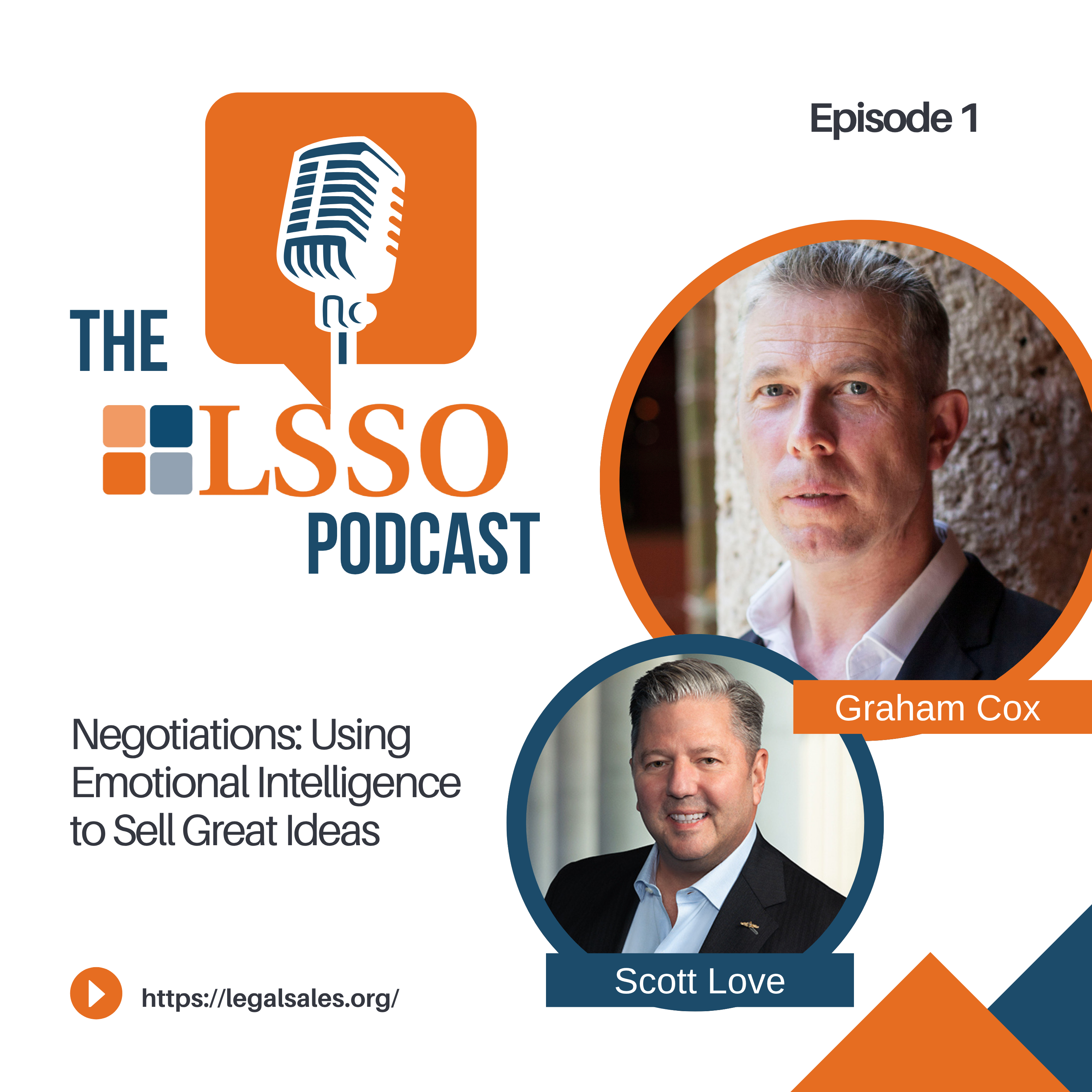
[Scott Love] Welcome to the inaugural episode of the LSSO podcast.
My name is Scott Love.
I'm the host for this series.
Today we're going to be talking with Graham Cox with Boundaries Edge about his presentation at 2026 Raindance, June 3rd and June 4th in Chicago, Illinois.
Graham, thanks for joining us on our inaugural episode.
[Graham Cox] Hey, I should say good afternoon, Scott.
Um in the US, it's um good evening if you're in Scotland.
I I'm up in the Highlands at this moment in time.
Sadly, you can't see it, but beautiful evening here, but I'm sure it's nice over in the US at this moment in time.
But thank you.
[Scott Love] That's great.
And I'll be excited to meet you in person as well as everybody else at the Raindance conference in Chicago.
And so you're going to be speaking on the first day of the conference talking about negotiation using emotional intelligence to sell great ideas.
So I thought it might be good for us to have a conversation about negotiation in general in a law firm context.
And so the first question I had for you, Graham, where do you see most law firm partners most often give away value in their negotiations and what should they do differently in their moment?
What are some of your general ideas about that?
[Graham Cox] Yeah, it's quite quite a long topic, but generally I find within attorneys within the US, they are very good and exceptional at what they do.
Their default background is they're very intelligent people, they're very capable.
When they go into negotiation, sometimes they go in without expect expectation of a win that's too quick.
And logic doesn't doesn't win the day.
Society's behaviors changed over the last five or six years.
In the past you could look at a law firm, you could find it's reputable, you'd find a partner within law firm that's highly reputable and you'd make a logical decision about that instruction.
Nowadays, decision making has changed.
We've analyzed it to USC, we've looked at it with Harvard Business School and the subconscious mind, I emotional intelligence is playing a larger part in the decision making process.
So it's not that partners are better or worse than used to be in the past.
It's not about them.
It's about the client behavior that's ultimately changed.
[Scott Love] That's interesting.
Why do you say that?
What exactly about it has changed and why do you think that is?
[Graham Cox] Yeah, there's quite a lot of trends globally.
I've I've highlighted this fact.
One, we've started to move into a transactional relationship or a transactional world.
So people nowadays um will often transact online whether they're buying flights, um they'll transact online if they're trying to make smaller purchases.
But that limits and we're talking about other people, their emotional intelligence has arguably dropped 23% over the last six years.
So when attorney goes out to meet a client, they are 23% less likely to use the same decision making criteria as they've done in the past.
So they'll go a lot more with gut instinct.
How does it feel?
Does it feel like I can like that person?
Does it feel like I can trust that person?
Because it's only when we like and trust the person, are we getting assurance that we'll get a good result by hiring or instructing that attorney.
[Scott Love] Yeah, that's right.
That's right.
When you see law firm partners negotiating with a sophisticated in-house team or other people at the corner office, whether it's the CEO or the CFO, how do you think they should position themselves in a negotiation so they're not treated like a commodity or like everybody else?
What do you think about that, Graham?
[Graham Cox] Yeah, that's a huge area as well.
And again, I look at it from during the talk, I'll talk about a lot of areas, but one of the things is perspective.
Uh that's one of the things you'll learn from the world of espionage and spying.
I have a perception of you, Scott, you will have a perception of me.
But what I need to do is I need to alter your perception of myself to someone that I'm not a commodity, to someone that I can add value or trust.
So the first rule and we'll start to look during the talk is how you change someone's perception.
And again, we'll broadly if you're getting value, so if you look at pricing, so rates, well value is a perception too.
How much do I value you?
How much will I be willing to pay for you on an hourly fees or hourly rate?
So changing someone's perception of value will allow you to increase your pricing strategy too.
And a lot of bits about perception.
There are other aspects too, but we can cover them later during the talk as well.
[Scott Love] Sure, sure.
And so I'm I'm curious, how do you think we can change the perception about how we're being seen by our clients and prospective clients?
Is it something that people should pay attention to in their online presence?... Is it what they do in their thought leadership, getting ranked in chambers?
What are some of the things that you think law firm partners should be mindful of in changing how they're perceived?
[Graham Cox] Yeah, that's fascinating.
And again, we'll cover it during the talk as well.
It's less about the logical and more about the subconscious decision making.
Again, USC in California, um Professor Antonio Demasio there looked at how people make decisions, looking at FMRI scans, looking at pet scans, which are radio nucleide tracer.
We can watch how blood flows within the brain.
And it doesn't operate logically.
So if I get into perception, the first rule of perception is we perceive what we expect.
Second rule is we seek stimuli to confirm that expectation.
I'll cover all the rules, but what the trick is is understanding how that person will form a perception of you and therefore presenting the correct stimuli so they perceive you to be someone that's trustable, likable and valuable.
And again, I go back to the past, why couldn't I was important to do it now?
Generally people had greater powers of perception in the past because they had greater levels of human interaction.
Nowadays, the client your perspective meet will not be able to pick up on that stimuli.
So it becomes an incumbent upon a good attorney or a good negotiator to present the correct stimuli.
And that's what covers how you present the stimuli and then the client will change behavior.
[Scott Love] So when you think that law firm partners in the middle of a negotiation, how can they really build that trust?
What are some things that you've seen that a law firm partner can do to build that trust with that prospective client?
[Graham Cox] Yeah, again, a fascinating area and again, I'll cover it during the talk.
From a hostage negotiation perspective, um let me give you an example there.
In a hostage and I'll relate it to the the legal sector, but in a hostage negotiation, the hostage takers do not know you.
You don't have the ability to earn trust, commitment, consistency, reliability, honesty, sincerity.
There's a very different psychological skill set to build trust.
Again, I quote some of the research article produced by Harvard Business School that will state that 99% of people listen to this podcast are trustable people.
But only three out of 10 of you will be trusted at first sight.
The difference is a winner is a person that not can earn trust, but can build trust in order to be able to earn trust.
And again, that subconscious process, it's not a logical process in the brain.
For example, the first thing is implied trust.
So I look like I'm implying trust in you.
If you look at the classic hostage negotiation, I'll give you two hostages if you give me two dozen pizzas.
That is false.
Reciprocation is an element of persuasion.
You give to someone first before you ask for something in return.
And again, meeting a prospective client, that could be giving them appreciation, that can give them some bit of comfort or building that trust.
So I'll cover it during the talk, but it's lawyers are great because they're trustable, but it's not just about earning trust, it's about building trust so you can earn that trust.
[Scott Love] I like the fact that you're going to share this and I'm excited to hear all that.
What I wanted to do also, Graham, was find out more about your background, what did you do before you started consulting?
And then some specific examples of things that you've done and seen in the legal world, how you've helped law firms really increase their ability to do business development.
So tell us more about your background from when you started when you were younger, Graham Cox to where you are today, Graham.
[Graham Cox] Yeah, no, thank you, Scott.
And I'm going to be careful what I can and can't say.
Uh I mean I started off not people not interested background in astrogeochemistry.
Um the probably the most notable thing I used to work for Exxon in international sales and then Pepsico doing the same thing before 911 and I ended up commanding the UK specialist task force in Afghanistan.
Um and then getting into Iraq where I worked with the US both in Afghanistan, Iraq.
Um after that, I went into the world of what we call strategic intelligence, but at a very senior level, running operations, but the operations we're running were intelligence operations.
So we'll call strategic back channel negotiations.
And again, it's fascinating from that perspective because let me give you an analogy or an example.
In that world, you don't have a price, you don't have a product, you don't have a promotion and you don't have a position.
Now again, if we went to the title of my talk, negotiations, using emotional intelligence to sell good ideas.
Well in my job, I wasn't selling good ideas.... I was using emotional intelligence to get someone who was ideologically opposed to me or my country or the US, turn them completely so they would betray their own country, risk their own life for someone who they didn't believe in when we first met.
And it's skill set from that environment that I would call is purest because sometimes within law firms, to give an example of helping within law firms, law firms are very good.
They build what we call corporate brand credibility.
They build personal brand credibility.
But sometimes, if you strip away the price product promotion position, you go to the core nature of it, it is two people that are meeting.
And again, it's using the techniques from that that when it comes on to supporting law firms, some of the bigger ones in the US and also particularly in the northeast, um but also in in London and the circle firms there as well.
It is ensuring that attorneys and partners have the proper negotiation skills they deserve because they definitely do deserve it to undertake a challenging job, not just to convert people one out of two times, but 100% of the time because if they are good, which they are, why wouldn't anyone ask for that instruction?
Hopefully that gives you a bit of an overview to say it's not an easy process.
Again, through my own personal example, some very nerve racking processes trying to convert people in very end life threatening scenarios.
But again, that also helps because it's not a guesswork, it's not a game, it's not a theory, it's not an idea.
This is real life.
Get it wrong in a negotiation, you lose your life.
Same in a law firm.
Get it wrong, you lose your reputation.
[Scott Love] What's something that you've learned that surprised you the most over the career over the years, Graham, in your career?
[Graham Cox] Probably the surprising thing and probably maybe the saddest thing as well is that through our education system through school, we're not really taught emotional intelligence.
Some of the basic level, some of the instance you will see geopolitically.
And I can't name them for very specific reasons, but major global things that have changed the course of history, which you would think were a logical decision that someone's made, actually have been nothing to do with logic whatsoever.
And you'll see academies trying to understand the mind of terrorists.
But all these academies fail to realize that person may be a strong religious advocate or something else that's influencing their decision.
It's trying to understand what really drives and motivates someone's decision.
[Scott Love] So tell me when you made the change to doing consulting, speaking to the legal industry and I'm sure you work with other industries.
But tell me what you've done in that regard.
Have you spoken at a lot of legal conferences?
I've Googled you.
I've seen you that you've spoken a few times at other different types of legal events.
But what have you tell our listeners what you've done in terms of speaking to the legal industry, Graham?
[Graham Cox] Yeah, and I mean I try and keep it fairly humble.
Um but I have now delivered keynote talks in 29 countries.
So of an international persuasion.
In the legal sector, we've done most of them uh got Lex Monday, the managing partners, global managing partners conference as well.
Um some of our legal networks um where I've been involved in as well to deliver the keynote talks.
But particularly in law firms you ask me, why the relevance of law firms to the world of intelligence?
Well, it's fascinating because as a former spy, the agents you're most likely to recruit are attorneys.
Why?
Because if I'm trying to infiltrate somewhere like Russia, most presidents and politicians trust their attorney generals.
Everyone trusts their attorney.
Attorneys know a lot.
Attorneys are really important.
They know a lot of information and they carry a lot of trust.
Sure, they're not meant to betray that trust, but on a geopolitical scale when the when the stakes are higher, um they they do.
But many of the people who went into the intelligence sector actually started off with a background in the legal sector.
And that's where the the compatibility come in.
And again, predominantly from my background, why law firms?
Because attorneys are way better than selling.
It's not about selling.
They're diplomats.
They're negotiating, strategic level negotiations.
They're not selling.
And if you ask me sometimes when I've seen some of the legal training in the past, it's been based around sales.
It sales are important, but the word I tend to use for it is diplomatic negotiations.
[Scott Love] That's great.
I think that's definitely applicable for those that are dealing with sophisticated prospects where the attorneys are looking to solve significant problems.
What are some of the pitfalls you've seen most attorneys need to avoid when they're really growing in their emotional intelligence and when they're negotiating with their client prospects?
[Graham Cox] Yeah, it's always a curve.
It's interesting if you looked at um warfare, it's a very similar curve as well.
When people start off, soldiers start off before they go into frontline combat, their confidence levels are fairly low.
the their output is fairly low.
They then start to learn and become much better.
There comes a point where they get fatigued.
And that that's that's an example of combat fatigue.
it's also in the world of the legal sector as well.
They become very good at what they're doing, but then they forget why they're good.
And then they take the shortcut and performance starts to drop.
So one of the pitfalls I would argue is it's not about rain makers who are really good because rain makers are really, really good.
and a rain maker is worth their weight in gold in a law firm.
Everyone knows that.
And that's why you have rain dance.
You want rain makers.
But the challenges, some of the best rain makers don't know why they're so good.
But if they know why they're good, they can mentor others.
They can train others.
They can teach others.
They can coach others.
So it's not just about being good, it's understanding why they are so good.
And many people who come to these talks will realize, I do that already, but I didn't know why I did it and I didn't know how it works.
And that can be a big difference as well in terms of growing their network and growing their junior members of staff, their associates and senior associates underneath.
[Scott Love] Yeah, that's great.
I think that makes a lot of sense.
When somebody comes and they see, oh, that's exactly why now they can be more deliberate, more intentional about doing why what they've done.
Now they know why that works.
Yeah.
Well, Graham, I'm excited to meet you in person and to hear you speak.
I know everybody else is and we'll see you and everybody else listening on June 3rd and June 4th in Chicago, Illinois.
Thanks for joining us today, Graham.
[Graham Cox] Thank you very much and I'll see you in Chicago.